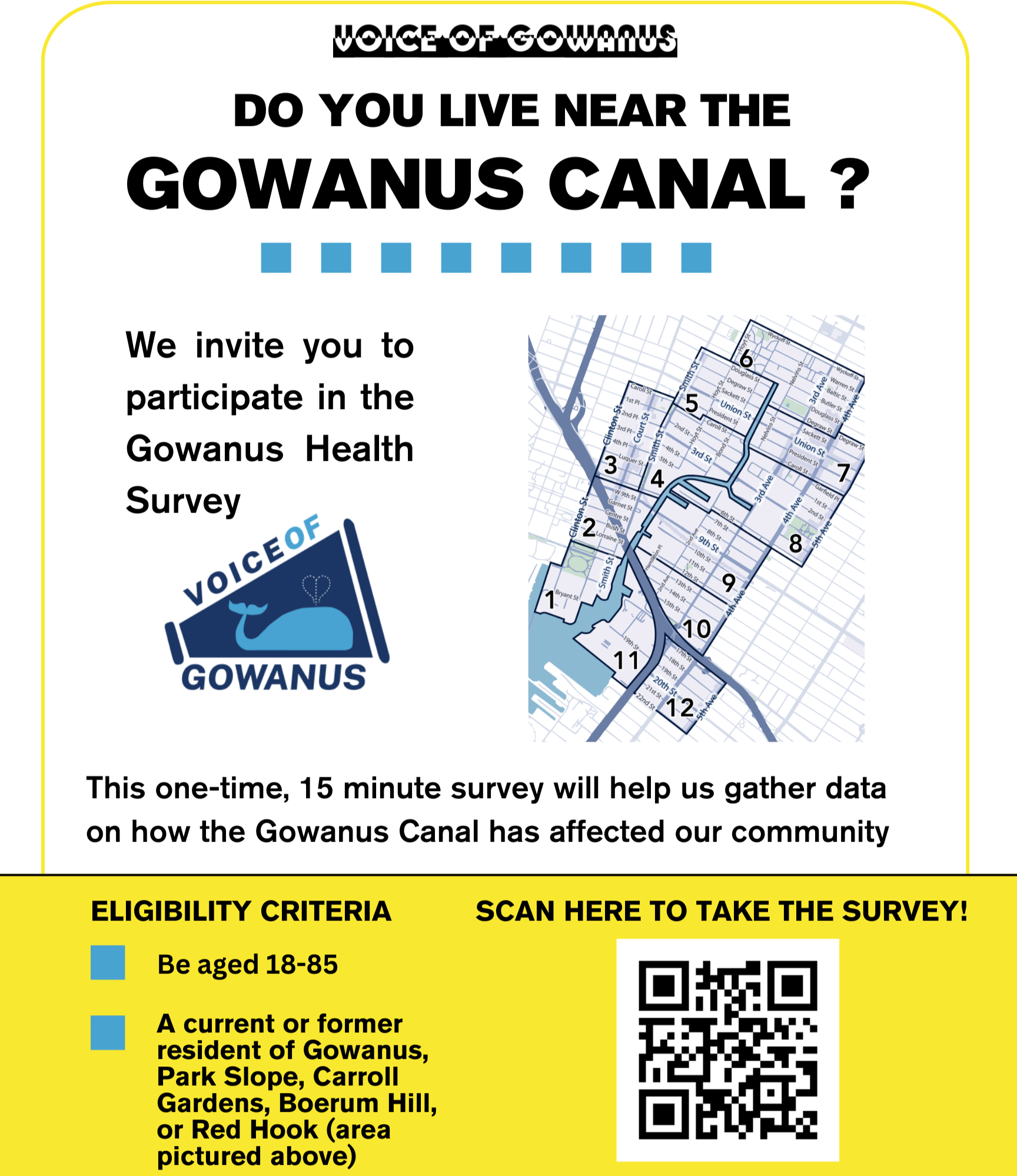
This survey concerns the environment surrounding, health of, and perceptions of the Greater Gowanus community as it relates to legacy toxicants, such as those at the Gowanus Canal Federal Superfund site and the surrounding NYS Superfund and NYS Brownfield sites, as well as the NYS Dept. of Environmental Conservation (DEC) Soil Vapor Intrusion (SVI) investigation area. We want to know if and how the people of Greater Gowanus have been affected by the chemicals we know are in the ground and in the air, substances like trichloroethylene (TCE), benzene, toluene, and ethylbenzene (BTEX), and other industrial contaminants that have persisted in the area’s soil for over a century.
We want to understand if there are any potential effects of these legacy toxicants on the community's health, including respiratory conditions, cancer, reproductive health outcomes, and other diagnosed conditions. We are documenting what residents have experienced in their environment, the odors, dust, air quality issues, and construction impacts they have noticed, and how they have responded, whether by installing air purifiers, changing their daily routines, hiring private remediation companies, or contacting authorities.
Beyond health, we want to understand the community itself: how long people have lived here, where they work, whether they feel informed about environmental risks, and whether they believe government agencies are taking adequate action. This survey maps these experiences block by block across Gowanus, Park Slope, South Slope, Carroll Gardens, Cobble Hill, Boerum Hill, and Red Hook to identify patterns while protecting individual privacy. The goal is to document the community's lived experience and provide evidence that can inform cleanup efforts and public health interventions, as well as ensure residents' concerns are systematically understood, so that it may shape future environmental and policy decisions.
One of the main catalysts for this study is the SVI issue in Gowanus, a public health concern that only rose to the broader public consciousness as a result of advocacy by Voice of Gowanus. Initial advocacy regarding SVI at one site led to publicity and a large-scale intervention by the DEC and NYS Department of Health, resulting in an expanded 40-block investigation area where hundreds of properties have been tested and 23 properties, to date, have been found in need of enivornmental remediation to avoid airborne risks to occupants due to soil vapor intrusion. These findings have set off alarm bells:
What other environmental health hazards in the Greater Gowanus area remain unaddressed?